Utah National Park Packing List: What to Pack in Each Season for the Mighty 5
What to pack for Utah's Mighty 5 national parks, including year-round hiking essentials, seasonal packing lists, and the gear I personally use exploring Southern Utah.


All photographs are © Roaming the Southwest unless stated otherwise. Unauthorized reproduction or use is prohibited.
Packing for Utah's Mighty 5? What you need depends on the season, elevation, and which parks you're visiting. Summer in Zion can mean triple-digit temperatures, while Bryce Canyon can still have snow and ice well into spring.
After more than a decade exploring Southern Utah, these are the essentials I bring on every trip, plus what I recommend packing for each season.
Essential Packing List for Utah's Mighty 5
Regardless of when you visit Arches, Canyonlands, Capitol Reef, Bryce Canyon, or Zion, these are the basics I recommend bringing.
My favorite gear is all linked below ↓| Category | What to Pack |
|---|---|
| Clothing | Hiking shoes, moisture-wicking layers, packable jacket, sun hat, and sunglasses |
| Hiking Gear | Daypack, 2–3L hydration system, headlamp, and portable charger |
| Safety & First Aid | Sunscreen, SPF lip balm, first aid kit, electrolytes, and satellite communicator (like a Garmin inReach) |
| Navigation | Downloaded offline maps and a paper backup |
| Other Essentials | America the Beautiful Pass, salty snacks, and camera gear |
Free Utah Mighty 5 Packing Checklist Printable
Want an easy way to keep track of everything you need for your trip? I've created a free Utah Mighty 5 Packing Checklist Printable with year-round hiking essentials, seasonal gear, and important reminders before you go. Download the one-page PDF, print it out, and check things off as you pack!
Spring Packing List for Utah's National Parks (March–May)
Spring is one of my favorite times to explore Southern Utah. Days can be warm, but mornings and evenings in the high desert are often chilly. Higher elevations, especially Bryce Canyon, can still have snow and ice well into spring.
What to pack for spring:
- Mid-weight layers, including a fleece or lightweight insulated jacket
- Hiking pants and moisture-wicking shirts
- Beanie and light gloves for cold mornings
- Rain shell for occasional storms
- Microspikes for snowy or icy trails
- Extra socks and waterproof hiking shoes for wet or muddy conditions
Summer Packing List for Utah's National Parks (June–August)
Summers in Southern Utah are HOT, with temperatures regularly exceeding 100°F at lower elevations. Sun protection and extra water are essential, and July and August can bring afternoon monsoon storms.
Not sure how much water to bring? Read my How Much Water to Drink While Hiking guide.
What to pack for summer:
- Lightweight, breathable clothing and long sleeves for sun protection
- Hiking shorts or lightweight pants
- Wide-brimmed sun hat and sunglasses
- Extra water capacity beyond your usual 2–3L
- Electrolytes
- Cooling towel or bandana
- Water shoes or hiking sandals for water hikes
- Lightweight rain shell
Fall Packing List for Utah's National Parks (September–November)
September can still feel like summer in Southern Utah, but mornings and evenings get cooler as fall progresses. By November, higher elevations like Bryce Canyon can already have snow and icy trails.
What to pack for fall:
- Moisture-wicking shirts and hiking pants
- Mid-weight layers, including a fleece or insulated vest
- Packable jacket for chilly mornings and evenings
- Beanie and light gloves, especially later in the season
- Rain shell for occasional storms
- Waterproof hiking shoes or boots
- Microspikes for late-season snow and ice
Winter Packing List for Utah's National Parks (December–February)
Winter is one of my favorite times to visit Southern Utah's national parks. Crowds are generally smaller, but temperatures can drop well below freezing, especially at Bryce Canyon. Snow and ice are common at higher elevations, and shaded trails can remain icy even when daytime temperatures warm up.
What to pack for winter:
- Thermal base layers and moisture-wicking clothing
- Insulated jacket and warm mid-layers
- Warm hat, insulated gloves, and wool socks
- Waterproof hiking boots
- Microspikes for icy trails
- Hand warmers
- Thermos for hot drinks
National Park Pass & Entrance Fees
Before heading to Utah's Mighty 5, don't forget your national park pass! Arches, Canyonlands, Capitol Reef, Bryce Canyon, and Zion all charge entrance fees.
If you're visiting multiple national parks, the America the Beautiful Pass may save you money compared to paying individual entrance fees, depending on your eligibility and travel plans.
Read my America the Beautiful Pass Guide for current prices, eligibility, and what the pass covers.
My Favorite Hiking Gear for Utah's National Parks
After more than a decade exploring Southern Utah, these are some of my favorite hiking essentials. I prioritize quality over fast fashion, so some recommendations come with a higher price tag. But I'd rather invest in gear that lasts for years than constantly replace cheaper alternatives. Everything below is gear I've personally used and recommend.
Hiking Boots
- Danner Mountain 600 – My tried-and-true hiking boots. I'm on my third pair after putting more than 500 miles on each of my previous pairs. They're also waterproof.
Trail Runners
- Salomon Speedcross GTX (Women's) – My go-to trail runners. These are the waterproof Gore-Tex version I wear most often. Men's version here.
- Salomon Speedcross (Non-GTX) – Just as comfortable without the waterproofing. I switch between the two depending on conditions and what's on sale. Men's version here.
Hiking Sandals
- TEVA Hurricane XLT2 – I SWEAR by these sandals. I've hiked up to 10 miles in them, including trails with significant elevation gain like Professor Creek and the Subway. They're comfortable, supportive, and one of my favorites for water hikes.
Hiking Leggings
- My Favorite Lululemon Align Dupe – Around $25 on Amazon. I buy the Essential fit, and they run true to size.
- Brushed Fleece-Lined Winter Leggings – A warmer option for cold-weather hikes, with a soft brushed fleece lining for extra insulation.
Base & Mid Layers
Not sponsored by PAKA in any way, but I'm genuinely obsessed with their products. Hey PAKA, reach out to your girl!
- PAKA Women's Aire Long Sleeve – My favorite lightweight long sleeve. Comfortable enough to wear on its own or as a base layer when temperatures drop. I size down in this one and wear it as my baselayer. I wear a medium by itself and the small as a baselayer.
- PAKA Sol Sun Hoodie – My go-to for hiking in the sun in both the desert and mountains. I prefer wearing a lightweight sun hoodie over constantly reapplying sunscreen to my arms.
- PAKA Costa Sweater – My favorite layering sweater and the perfect midlayer for cooler hikes. Easy to throw over a base layer when temperatures drop.
Jackets & Puffers
- Arc'teryx Atom Hoody (Women's) – One of my favorite lightweight midlayers. It's easy to pack and perfect for layering on cooler hikes. I usually wait for a sale because Arc'teryx isn't cheap, but I've found their quality and durability justify the price.
- Mammut Broad Peak IN Hybrid Jacket (Women's) – One of my two go-to puffers, featuring 800-fill down insulation. Incredibly lightweight, easy to pack, and surprisingly warm.
- Mammut Broad Peak IN Hooded Jacket (Women's) – My other favorite puffer, also with 800-fill down insulation, but with a hood for extra warmth.
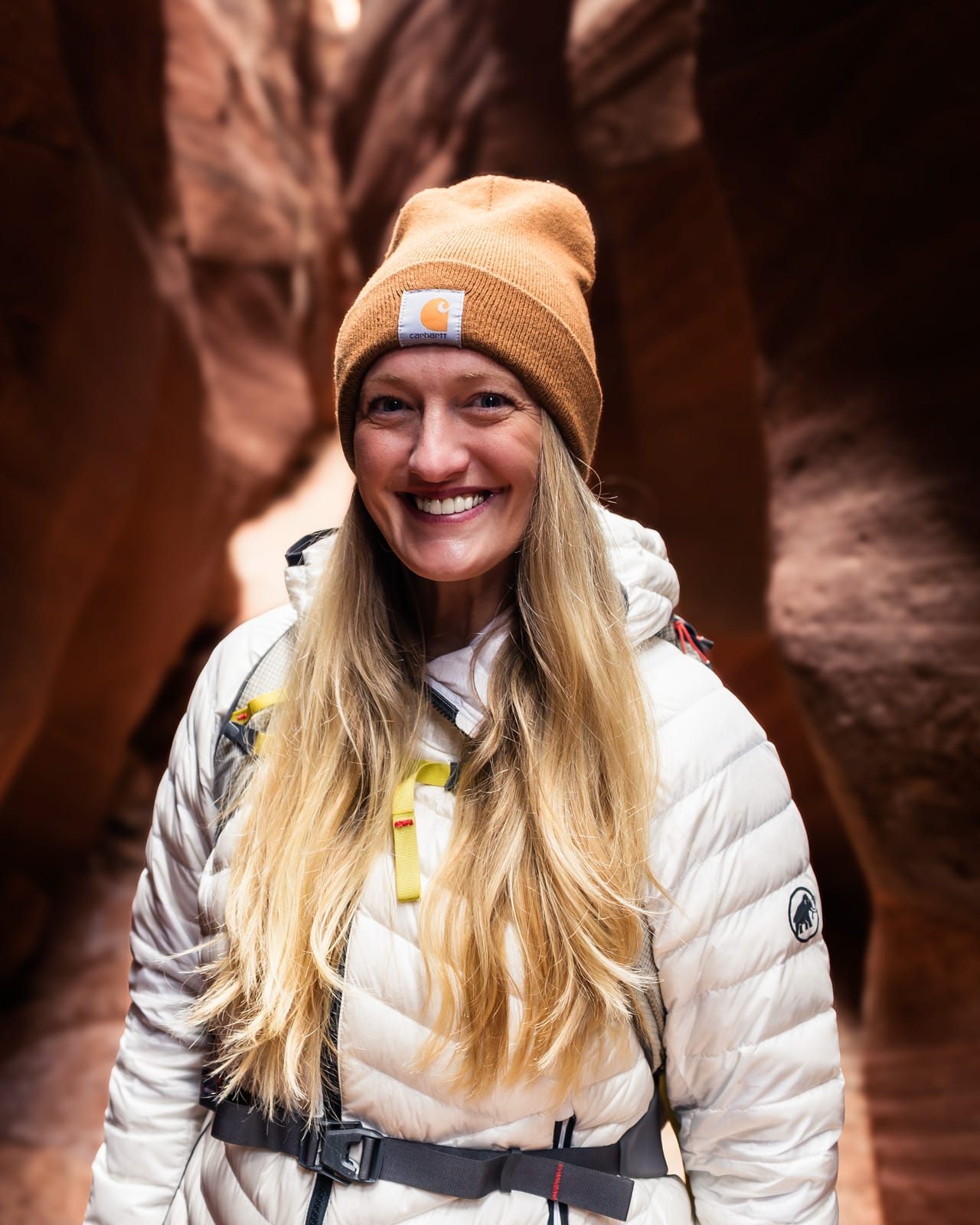
If you've seen me wearing a red or white puffy in my Instagram photos, it's Mammut! Even the jacket in my About Me section is Mammut. I wear these on probably 99% of my adventures, especially in the desert. They're incredibly lightweight, packable, and warm.
Hiking Accessories & Traction Gear
- Carhartt Beanies – Carhartt beanies will forever be my favorites. Perfect for chilly mornings and winter hikes.
- Kahtoola MICROspikes – I've had my Kahtoolas for over 10 years, and they're still going strong. They're more expensive upfront, but the durability makes them worth every penny.
- Budget-Friendly Amazon Microspikes – These work great for occasional winter hikes, and I keep a pair as a backup. In my experience, they typically last a season or two before needing replacement. If you hike regularly in winter, I'd spend the extra money on Kahtoolas.
- Smartwool Performance Hike Targeted Cushion Mid Crew Socks – Smartwool is my go-to for hiking socks year-round, and these are my favorite style. I love the targeted cushioning, comfortable fit, and moisture-wicking merino wool.
- Mid-Gaiters – Great for keeping sand and small rocks out of your shoes, especially on Southern Utah's sandy trails.
Navigation & Safety Gear
- Garmin inReach Mini – One of my most important pieces of hiking safety gear, especially when exploring remote areas without cell service. It allows me to send messages, share my location, and contact emergency services via satellite with an active subscription. These go on sale around Black Friday and REI specific sales.
- Gaia GPS App – My go-to app for planning hikes, downloading offline maps, and recording GPX tracks. I use it to navigate trails and keep track of my routes, especially in areas where cell service is limited.
Sunscreen
- Trader Joe's Daily Facial Mineral Sunscreen SPF 40 – One of my favorite everyday facial sunscreens, both on and off the trail. (purchase in-store)
- Trader Joe's Invisible Gel Body Sunscreen SPF 40 – My favorite body sunscreen for hiking and spending time outdoors. (purchase in-store)
- Sun Bum SPF 30 Daily Glow Tinted Face Sunscreen Lotion – My go-to when I want a little tint along with my daily sun protection since I rarely hike in make-up.
Final Tips for Packing for Utah's Mighty 5
You don't need to bring everything on this list for every trip. What matters most is packing for the season, checking the forecast, and remembering that conditions can vary significantly between parks. I've experienced everything from scorching desert heat to snow-covered trails in Southern Utah, sometimes on the same trip!
If you're planning to visit multiple parks, pack layers you can easily add or remove, bring more water than you think you'll need, and don't underestimate how cold the desert can get after sunset.